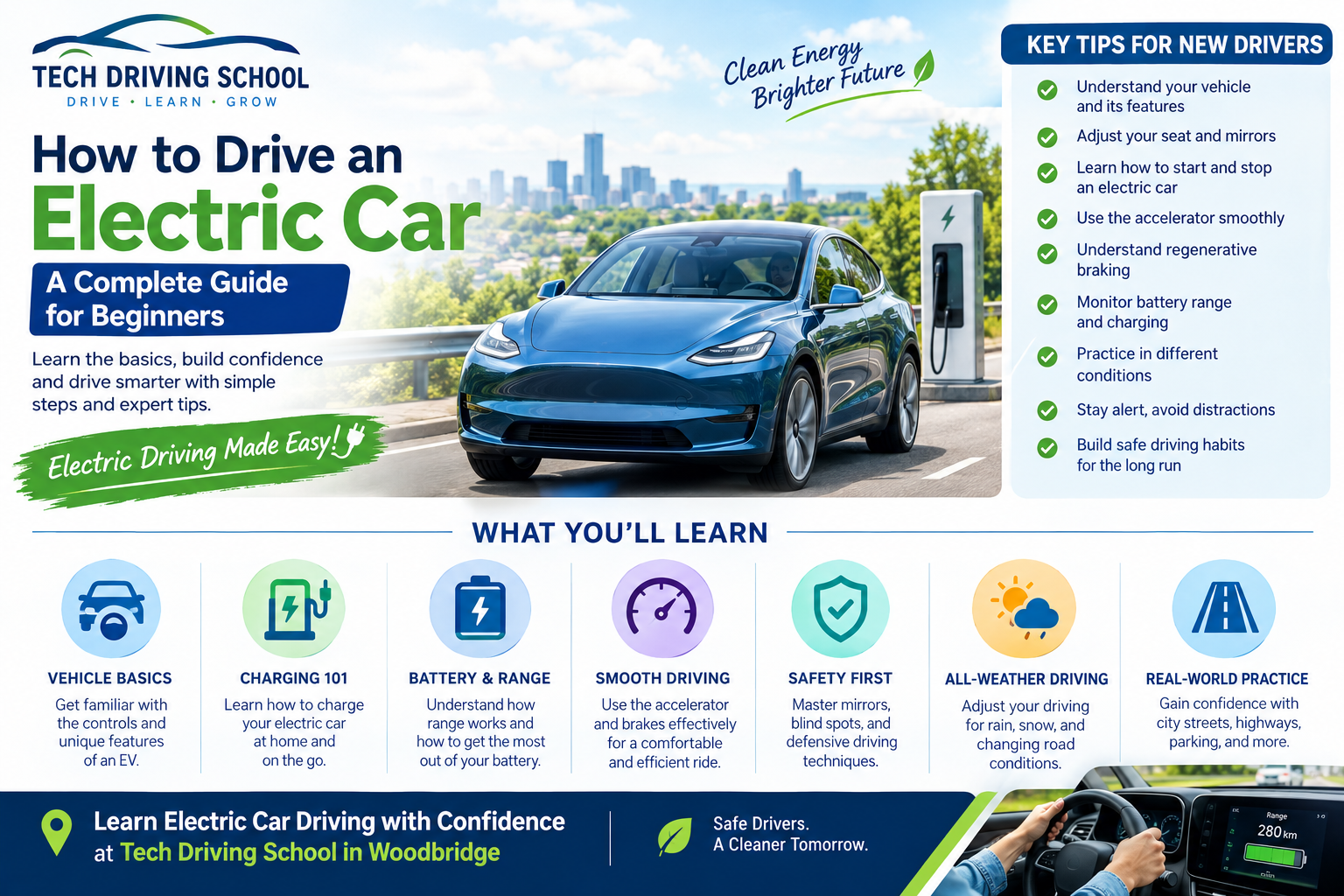

Electric vehicles (EVs) are becoming increasingly popular as more drivers look for efficient, modern, and environmentally friendly transportation. Although an electric car may look and feel similar to a traditional gasoline-powered vehicle, there are several important differences that new drivers should understand.
From one-pedal driving and regenerative braking to charging and battery management, learning how an EV works can make your driving experience safer, smoother, and more enjoyable.
If you are driving an electric car for the first time, this guide will explain the basics of electric car driving, including how to start and stop an EV, accelerate smoothly, use regenerative braking, charge the battery, and develop safe driving habits.
The biggest difference between an electric car and a traditional gasoline-powered vehicle is how it produces power.
A gasoline vehicle uses an internal combustion engine that burns fuel to generate power. An electric vehicle uses one or more electric motors powered by a rechargeable battery.
Because electric motors deliver power differently, EVs often feel very responsive when you press the accelerator. Many electric cars can accelerate quickly and operate much more quietly than gasoline-powered vehicles.
For a new driver, these differences may require some adjustment.
The good news is that the basic principles of safe driving remain the same:
Before starting your first EV drive, take some time to understand the vehicle.
Different electric cars have different controls and features, so don’t assume everything works exactly like a gasoline-powered vehicle.
Before leaving, locate:
Take a few minutes to familiarize yourself with the dashboard and controls while the vehicle is safely parked.
This is especially important if you are borrowing or renting an electric vehicle.
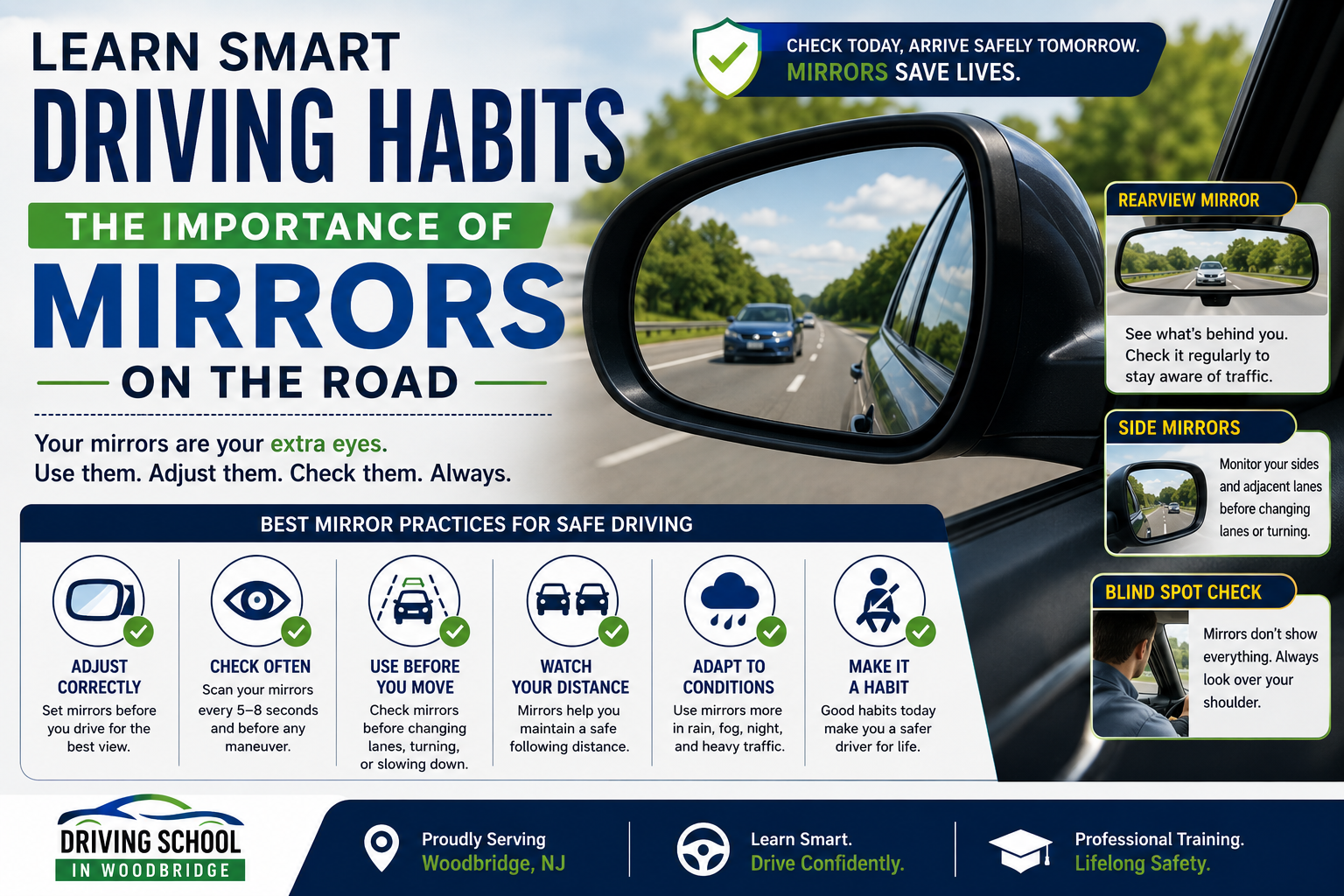
Proper seating and mirror adjustment are essential for safe driving regardless of the type of vehicle you operate.
Before starting the vehicle, adjust your seat so that you can comfortably reach the pedals while maintaining good visibility.
Next, adjust your mirrors.
Your rearview mirror should provide a clear view behind your vehicle. Your side mirrors should help you monitor vehicles approaching from adjacent lanes while minimizing unnecessary blind spots.
Remember that mirrors do not completely eliminate blind spots. Always perform an appropriate shoulder check before changing lanes.
Starting an electric vehicle may feel different because many EVs operate almost silently.
Some electric cars use a start button, while others may activate when the key or phone is detected.
A typical process may include:
Always follow the specific instructions in your vehicle’s owner’s manual.
One important difference for beginners is that an EV can be ready to move without producing the engine sounds you might expect from a gasoline car.
Always assume the vehicle is capable of moving when it is powered on.
Electric motors can deliver torque very quickly.
As a result, an electric car may respond immediately when you press the accelerator.
For new EV drivers, smooth acceleration is an important skill.
Instead of pressing the accelerator aggressively, gradually increase pressure until you reach the desired speed.
Smooth acceleration helps you:
As you become familiar with the vehicle, you’ll learn how much accelerator pressure is required for different situations.
One of the most important concepts in electric car driving is regenerative braking.
When an EV slows down, its electric motor can operate in a way that helps recover some energy and return it to the battery.
This is different from simply using the conventional friction brakes.
Depending on the vehicle, regenerative braking may become noticeable when you release the accelerator. Some EVs can slow down significantly without the driver pressing the brake pedal.
This feature is sometimes called one-pedal driving.
However, the exact behavior varies from vehicle to vehicle.
New drivers should practice regenerative braking in a safe, low-traffic environment before relying on it heavily.
Some electric vehicles allow drivers to control acceleration and much of their deceleration using primarily the accelerator pedal.
When the driver releases the accelerator, the vehicle slows down because of regenerative braking.
This can make city driving convenient once you become accustomed to it.
However, new drivers should remember that one-pedal driving does not mean the brake pedal is unnecessary.
You should still be prepared to use the brake pedal whenever additional stopping power is needed.
During driving lessons, practicing this feature gradually can help you understand how quickly your vehicle slows when you release the accelerator.
Unlike a gasoline vehicle, an EV’s available driving range is directly connected to the battery’s state of charge and other conditions.
Your dashboard will normally display an estimated remaining range.
However, the estimate can change depending on:
Don’t wait until the battery is nearly empty before thinking about charging.
Plan longer journeys in advance and identify suitable charging locations along your route.
Charging an electric car is an essential part of EV ownership.
Depending on the vehicle and charging equipment, charging can take different amounts of time.
You may encounter different types of charging equipment, including home charging equipment and public charging stations.
Before taking a long trip, consider:
Charging habits will become easier to manage as you gain experience with your vehicle.
New drivers should gradually practice electric car driving in different environments.
Start with quiet roads and gradually move toward more challenging situations.
Practice:
Learning in stages helps build confidence without overwhelming a beginner.
A professional Driving School in Woodbridge can provide structured instruction and help students develop safe driving habits in real-world conditions.
Electric cars can produce significantly less engine noise than gasoline vehicles, especially at lower speeds.
This creates an important safety consideration.
Pedestrians, cyclists, and other road users may not hear an approaching EV as easily as they might hear a traditional vehicle.
Drivers should therefore pay extra attention to their surroundings.
Watch carefully for:
Never assume someone has heard or noticed your vehicle.
Mirror awareness is just as important in an electric vehicle as in any other car.
Before changing lanes:
Avoid staring at your mirrors for too long. Mirror checks should be brief while maintaining attention on the road ahead.
Developing good observation habits is one of the most important parts of professional driver training.
Many electric vehicles offer different driving modes.
Depending on the model, you may find options related to:
Each mode may change the vehicle’s response, acceleration, braking feel, or energy usage.
New drivers should start with a predictable, easy-to-control setting and learn the vehicle’s features gradually.
Always consult the owner’s manual to understand what each mode does.
Weather affects every type of vehicle, including electric cars.
Rain, snow, ice, and strong winds can affect traction, visibility, stopping distance, and overall driving conditions.
In poor weather:
Never assume that advanced vehicle technology eliminates the risks created by poor weather.
The advanced technology found in many EVs can make driving more convenient, but it can also create distractions.
Large touchscreen displays, navigation systems, smartphone connections, and entertainment features should not take your attention away from the road.
Before starting your trip:
Your primary responsibility is always to control the vehicle safely.
Parking is another area where new EV drivers should practice.
Many electric cars have cameras, sensors, and parking assistance features. These technologies can be useful, but drivers should not depend entirely on them.
Practice:
Use mirrors, cameras, direct observation, and appropriate shoulder checks together.
Learning to drive an electric car with a qualified instructor can make the transition much easier.
A professional Driving School in Woodbridge can help new drivers understand vehicle control, observation, defensive driving, traffic laws, and safe driving techniques.
Professional lessons can also help students become comfortable with EV-specific features such as:
The goal isn’t simply to learn how to operate an electric vehicle. It is to develop safe habits that remain useful throughout your driving life.
Electric car driving can be an enjoyable and rewarding experience, especially once you understand how the vehicle responds and how its technology works.
Although EVs operate differently from traditional gasoline-powered cars, the fundamentals of safe driving remain the same. Drivers should stay alert, follow traffic laws, maintain a safe distance, check mirrors and blind spots, avoid distractions, and adjust their driving to road and weather conditions.
If you’re learning to drive or switching to an electric vehicle for the first time, taking professional lessons can help you build confidence and develop the right habits from the beginning.
With proper instruction, regular practice, and responsible driving behavior, you can make the most of your electric vehicle while keeping yourself, your passengers, and other road users safer.
92 Main Street WoodBridge, New Jersey 07095 USA
techdrivingschool [ @ ] gmail.com
7327504455
#000048